The Plan
A living plan, carried by those who have always carried the Earth.
The Indigenous Peoples' Plan for Planetary Regeneration (IPPPR) is a long-horizon framework convened by the Earth Elders Council to restore the ecological and cultural integrity of the planet's most vital territories. It is not a blueprint imposed from above — it is a weaving of mandates, protocols, and place-based commitments authored by Indigenous knowledge keepers themselves.
At its heart is a simple recognition: the lands, waters, and species most essential to planetary life are, almost without exception, the ancestral territories of Original Peoples. Their return to full stewardship is the most direct, scientifically grounded path to planetary regeneration.
What the Plan holds
Five threads, one shared horizon.
52 Bio-Cultural Territories
A planetary map of the regions whose ecological and cultural integrity is essential to the health of the whole — each engaged on its own terms.
Indigenous-led Stewardship
Decision-making, design, and governance held by the Original Peoples of each territory, in council with their elders and traditional authorities.
Bioculture & Bioeconomies
Restoration of the inseparable weave of land, language, knowledge, and species — and the regenerative livelihoods that sustain them.
Place-based Regeneration
Each of the 52 initiatives is engaged after listening deeply to the needs of community and land — a response to place, never a template.
Indigenous Knowledge Systems
Honoring traditional ecological knowledge as the foundational science of regeneration — the time-tested wisdom that has sustained Earth's most biodiverse territories across generations.
The Map
52 Bio-Cultural Territories
The Earth's living surface can be read as 52 bio-cultural territories — each a unique weave of ecosystem, climate, language, ceremony, and ancestral knowledge. The Earth Shield's work is to ensure each one of these territories holds a sovereign, Indigenous-led regeneration and protection strategy within this generation.
This is not a cookie-cutter approach.
Each of the 52 initiatives is shaped by listening deeply to the elders and communities of place. Every project emerges as a response to specific bio-cultural needs — to the land, the traditional guardians, their language, their unique ancient cultures, and the more-than-human life they steward. No two territories are alike, and no two strategies will be either.
The Earth's Bio-Cultural Territories
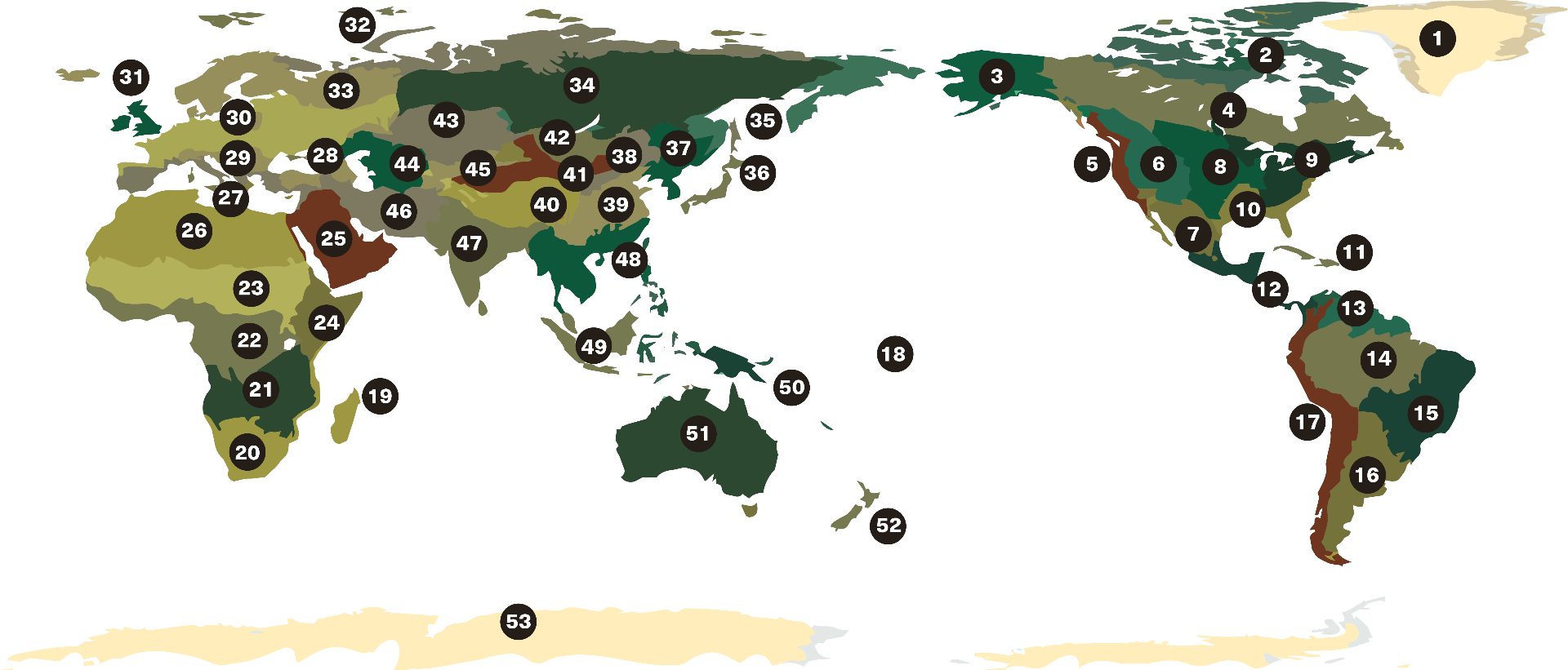
The 52 Territories
- 01Greenland
- 02Canadian Tundra
- 03Alaska
- 04Canadian Boreal Forests
- 05North Pacific Coast
- 06American West
- 07Mexican Drylands
- 08Great Plains
- 09Northeast American Forests
- 10Southeast American Savannas & Forests
- 11Caribbean
- 12Central America
- 13Upper South America
- 14Amazonia
- 15Brazil Cerrado & Atlantic Forest
- 16South America Grasslands
- 17Andes & South Pacific Coast
- 18Oceania Islands
- 19Madagascar & East African Coast
- 20Southern Afrotropics
- 21Sub-Equatorial Afrotropics
- 22Equatorial Afrotropics
- 23Sub-Saharan Afrotropics
- 24Horn of Africa
- 25Greater Arabian Peninsula
- 26North Africa
- 27Mediterranean
- 28Black Sea Forests & Steppe
- 29European Mountain Forests
- 30Greater European Forests
- 31Anglo-Celtic Isles
- 32Palearctic Tundra
- 33Scandinavia & Western Boreal Forests
- 34Siberia & Eastern Boreal Forests
- 35Sea of Okhotsk & Bering Tundra/Taiga
- 36Japanese Islands
- 37Northeast Asian Forests
- 38Mongolian Grasslands
- 39Central East Asian Forests
- 40Tibetan Plateau
- 41East Asian Deserts
- 42Altai-Sayan Mountains
- 43Kazakh Steppes & Hemiboreal Forest
- 44Caspian Sea & Central Asian Deserts
- 45Tien Shan Mountains
- 46Persian Deserts & Forests
- 47Indian Subcontinent
- 48Southeast Asian Forests & Seas
- 49Western Indonesia & Malaysia
- 50Eastern Indonesia & Australasian Islands
- 51Australia
- 52New Zealand
The Earth Shield's Role
The Earth Shield is the financial vessel of the Plan.
The Earth Shield Fund channels capital, partnerships, and long-term commitment into the territories named within the IPPPR — beginning with the launch projects in the Amazon, Mexico, and a forthcoming African bio-cultural territory. Every flow of resource is guided by the protocols of the Council and the consent of the peoples whose lands are stewarded.